
CERN’s Five-Yearly Review: Purpose, Process and Impact

All employers — especially intergovernmental organizations governed by their own legal frameworks — periodically assess whether the conditions offered to their personnel continue to meet organizational needs as well as evolving external conditions. At CERN this is a requirement laid out in Article S V 1.02 and Annex A1 of the Staff Rules and Regulations. The periodic reviews defined there include a “five-year general review of financial and social conditions”, usually called the five-yearly review and often abbreviated as 5YR. This fundamental institutional process shall ensure that the Organization’s financial and social conditions remain fit for purpose: recruiting, retaining and supporting its diverse international workforce. It is a well-defined process that can only be modified after a given exercise, for the next one.
Components of the Five-Yearly Review
The review must include basic salaries for Staff members, stipends for Graduates and subsistence allowance for MPAs. It may include any other financial or social conditions for all. The overall process is tailored to different categories of personnel:
For Staff Members
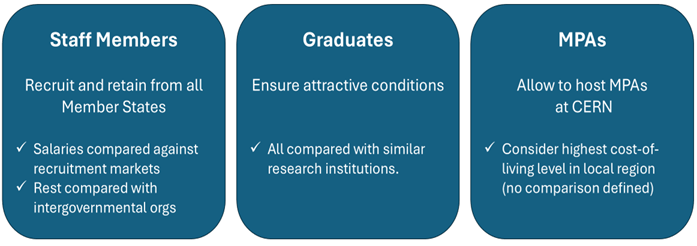
The objective is “to ensure that the financial and social conditions offered by [CERN] allow it to recruit and retain the staff members required for the execution of its mission from all its Member States [given that] staff members must be of the highest competence and integrity”. This includes comparing CERN’s salaries with the most competitive salaries offered by employers in the relevant recruitment markets and CERN’s other conditions with those offered by other intergovernmental organizations to ensure competitiveness.
For Graduates
The purpose is “to ensure that the financial and social conditions offered to graduates remain attractive compared to those of comparable research institutions”.
For Associated Members of the Personnel (MPAs)
The goal is to “to ensure that the financial and social conditions offered by [CERN] allow it to host [MPAs] in its research facilities, taking into account the highest cost-of-living in the local region of the Organization”. Unfortunately, no clear comparison basis or clear mechanism is defined to attain that goal.
How the Review Works
The five-yearly review typically spans at least two years from the start of data collection to final implementation.
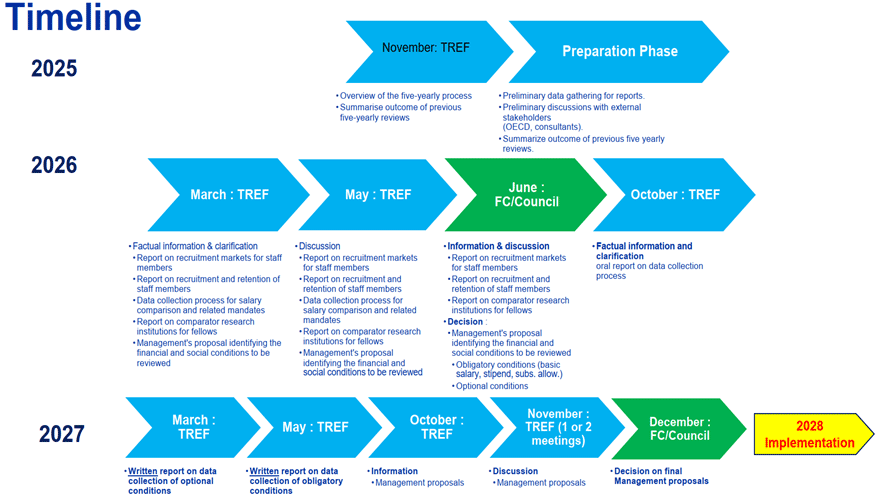
(Courtesy of HR department)
Key aspects of the process include:
- Data collection and benchmarking: Comprehensive surveys are conducted to benchmark benefits according to the comparisons mentioned above.
- Concertation: Proposals are developed and refined in concertation between CERN’s management and CERN’s Staff Association, before being presented for feedback to Member State representatives through the Tripartite Employment Conditions Forum (TREF).
- Review and approval: After going through the concertation process, the resulting proposals are submitted to CERN Council for approval.
It should be noted that, at any time, feedback from Member States or members of personnel (e.g. referendum) may send back the proposals to the initial concertation step for the elaboration of enhanced proposals.
What Has Actually Happened in Recent Five‑Yearly Reviews
For Staff members, salary surveys conducted as part of the 2010, 2015 and 2021 reviews consistently showed significant gaps between CERN salaries and those of its main recruitment markets. These gaps were estimated at around 41% in 2010, 31% in 2015 and still close to 9% in 2021 (changes in the methodology are believed to have contributed significantly to the reduction of the gap). Despite this persistent evidence, no general salary catch‑up was implemented through the mandatory part of the reviews, allowing the gap to persist.
The most substantial changes affected career structures rather than salaries. The 2015 review paved the way for the 2016 career reform, with the introduction of the “MERIT” system which significantly reduced recurrent advancement. This slower salary progression resulted in significantly reduced overall lifetime earnings and lower pensions at the end of the carrier. The 2021 5YR did not compensate for these effects, leaving career dissatisfaction unresolved.
For graduates, fellows and associated members of the personnel, financial conditions were repeatedly declared “attractive” in official conclusions. In practice, however, stipends were frozen or reduced over time, and subsistence allowances remained unchanged despite the consistently high cost of living in the Geneva region. The launch of the new Graduate Programme in 2022 even resulted in a significant reduction in stipends (for Early Career Graduates, a.k.a. Origins). Across the three reviews, the mandatory 5YR components led to no tangible improvements.
Finally, the 2010 review introduced major reforms to health insurance and pensions, restoring financial stability but at the cost of higher contributions, pension under‑indexation and a higher retirement age.
Overall, the last three Five‑Yearly Reviews show a consistent tendency to prioritize budgetary consolidation over strategic investment in attractiveness, leading to a gradual erosion of CERN’s competitiveness compounded by an increasingly demanding labour market. But this was not always the case: the 2000 and 2005 Five-Yearly Reviews did address CERN’s lack of competitiveness by improving various elements of the compensation package. In both cases, this was a well-thought-out and conscious decision of Management, supported by the Staff Association. Will the present Management be as forward-looking? We hope so and we are determined to make a solid case for it. This is all the more needed as since the last 5YR, several Member States have begun voicing concern that their nationals are under-represented at CERN, an issue that is naturally exacerbated by the continued erosion of employment conditions.
What now? The SA needs your input
To complement the institutional analyses and benchmarking exercises, a dedicated consultation of personnel will be organized by the SA in the context of the upcoming review. The aim is to capture lived experience and expectations directly from those concerned. Three separate surveys will be conducted - one for staff members, one for graduates and fellows, and one for associated members of the personnel (MPAs) - reflecting the different employment frameworks and challenges faced by each group.
This approach will allow for more targeted input from all of us on financial benefits, careers, working conditions and social benefits, and ensure that future discussions are informed not only by external comparisons, but also by the concrete realities experienced across the Organization.
As in the past, your responses will be treated with the strictest confidentiality. This will be ensured by the team of the University of Geneva responsible for carrying out the survey. No one at CERN will have access to individual responses, and your anonymity is fully guaranteed. The Staff Association will receive only anonymized data and a report, which you will be able to consult. A summary of the results will also be shared with the entire personnel.
Make your voice heard, provide your input, come to our public meetings and answer our survey!
(For further explanation and analysis of the 5YR, please consult our recent seminar on the subject)